
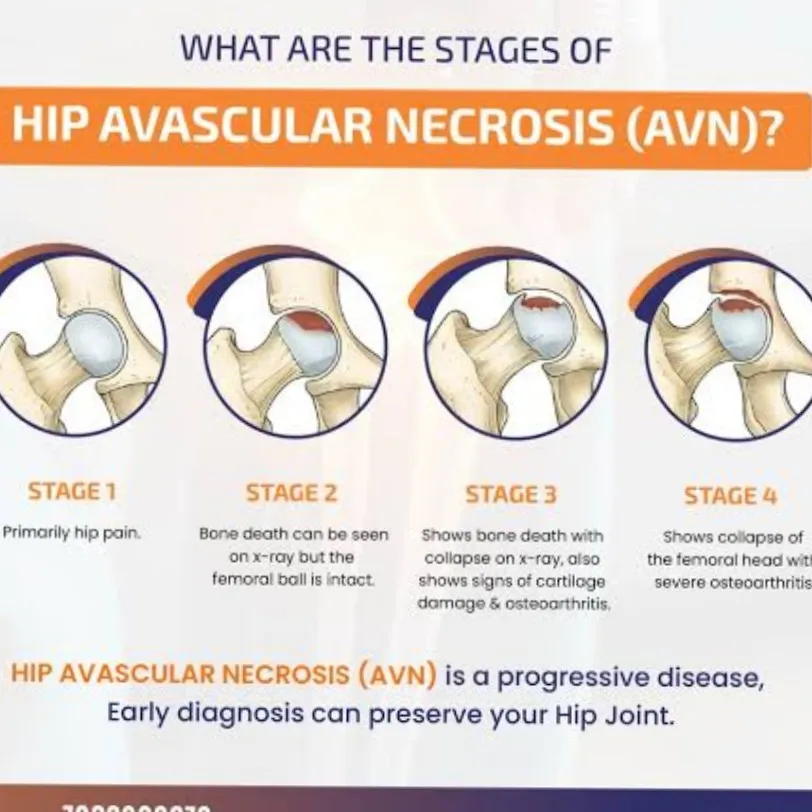
Avascular Necrosis (AVN) can be classified in a few different ways depending on cause, location, and pattern of bone involvement. Here are the main types of AVN:
🔹 1. Based on Cause (Etiology)
Traumatic AVN
Occurs after injury (fracture or dislocation)
Blood supply to bone is directly disrupted
Common in femoral neck fractures, hip dislocations
Non-Traumatic AVN
No direct injury
Caused by conditions like:
Steroid use
Alcohol abuse
Sickle cell disease
Autoimmune disorders
🔹 2. Based on Number of Bones Involved
Unifocal AVN
Involves a single bone (most common: femoral head)
Multifocal AVN
Involves multiple bones (≥3 sites)
Often associated with systemic diseases or long-term steroid use
🔹 3. Based on Location (Common Sites)
Hip (Femoral Head AVN) – most common
Knee (Femoral condyle AVN)
Shoulder (Humeral head AVN)
Ankle (Talus AVN)
Wrist (Lunate – Kienböck’s disease)
🔹 4. Special Types
Legg-Calvé-Perthes Disease
AVN of femoral head in children
Kienböck’s Disease
AVN of lunate bone in wrist
Spontaneous Osteonecrosis of Knee (SONK)
Sudden onset knee AVN, usually in older adults
🔹 5. Based on Radiological/Clinical Staging (Ficat & Arlet)
Stage I – Normal X-ray, MRI changes
Stage II – Sclerosis/cysts visible
Stage III – Subchondral collapse (crescent sign)
Stage IV -Joint destruction & arthritis
Keywords