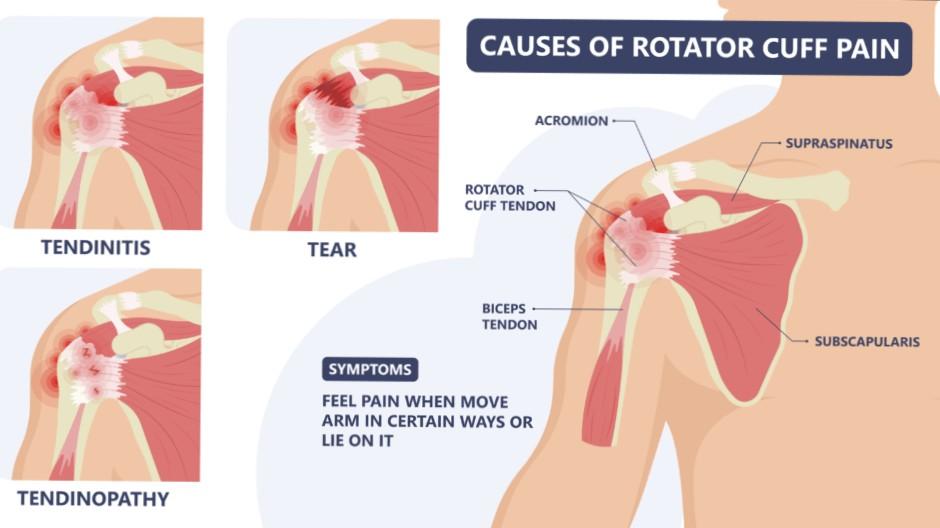


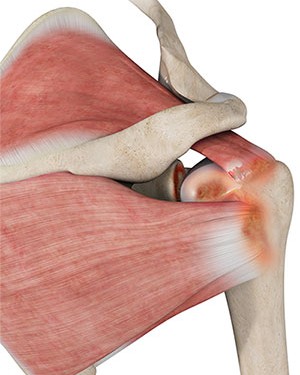
your shoulder. He will want to know the level of your pain, and what limitations you have. A physical examination is done. Range of motion and strength of the shoulder muscles will be evaluated. Your doctor will want to look at your shoulder to see if there is bony deformity, or atrophy (shrinkage) of the muscles. With a complete rotator cuff tear, moving the arm away from the body can be nearly impossible. If your doctor lifts your arm for you, and you cannot hold it up, this is called a positive Drop Arm Test. This usually means the rotator cuff is torn.
Your doctor will request X-rays of your shoulder. X-rays show the shape of the bones and joints. When the rotator cuff is torn, the shoulder will often ride high, meaning that it sits higher in the joint than it should. It can also show how much damage has occurred to the joint surfaces. Magnetic resonance imaging (MRI) or a computerized tomography (CT) scan may be necessary to complete the evaluation or plan treatment.
What is the treatment?
Nonsurgical treatment:
Care that includes physiotherapy, ice, heat, and anti-inflammatories is tried first. The goal of treatment is to reduce pain, and increase range of motion and function. Corticosteroid injection into the shoulder joint is also sometimes helpful. Steroids are very powerful anti-inflammatory medications that can reduce pain temporarily. These injections will not heal the tear but may give pain relief for several weeks to months. If arthritis of the shoulder is advanced, and pain is continuous and severe, surgery may be the best option available.
Surgical treatment:
Cuff tear arthropathy is the result of long standing lack of rotator cuff function. In almost all cases, repair of the rotator cuff tear is no longer an option. Surgery for cuff tear arthropathy is done when pain and decreased motion continue after conservative care. The simplest surgical procedure to try and improve the situation is a debridement. During a debridement, the surgeon will surgically remove (debride) any inflammed tissue, bones spurs and loose flaps of tendon tissue that may be catching in the joint and causing pain. This procedure may reduce pain, however, it does not always improve range of motion, strength, or function of the shoulder.
Patients with this type of arthritis would seem to be good candidates for a shoulder replacement, but replacing the shoulder in the traditional fashion has not been successful. Replacing the shoulder with a special type of artificial shoulder joint is becoming more popular. This procedure is called a reverse shoulder replacement. The "normal" artificial shoulder was designed to copy our real shoulder. In the "reverse" replacement, the artificial socket is put where the native ball, or humeral head, use to be, and the artificial ball is put where the native socket, or glenoid, used to be.
This new design leads to a much more stable shoulder joint that can function without a rotator cuff. The final result is a shoulder that functions better, is less painful and can last for years without loosening.