
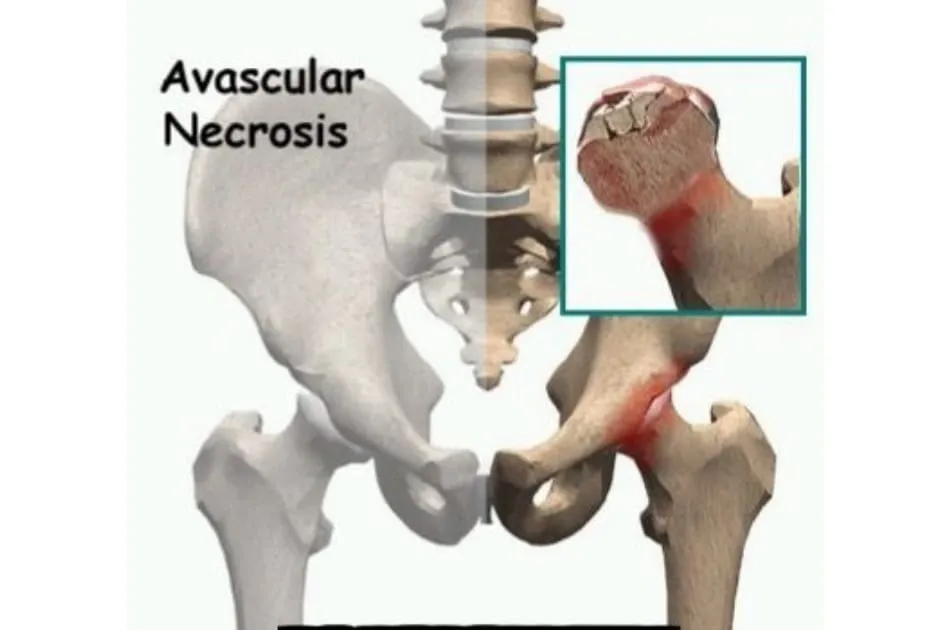
Avascular Necrosis
Avascular necrosis (AVN), also called osteonecrosis, aseptic necrosis, or ischemic bone necrosis, is the death of bone tissue caused by loss of blood supply. Without adequate circulation, bone cells die, leading to structural collapse and joint dysfunction. The condition most often affects the hip, but can also involve the shoulder, knee, and ankle.
Key facts
Also known as: Osteonecrosis, aseptic necrosis, ischemic bone necrosis.
Typical onset: Ages 30–50; more common in men
Common sites: Femoral head, humeral head, knee, and ankle
Major risk factors: Trauma, corticosteroid use, alcohol abuse, and certain systemic diseases
Primary treatments: Core decompression, bone grafting, osteotomy, or joint replacement
Pathophysiology
Bone tissue requires constant blood flow for nutrient delivery and repair. When this flow is interrupted—by trauma, vessel injury, fat emboli, or thrombosis—bone cells undergo necrosis. As necrotic areas fail to remodel, microfractures form, progressing to collapse of the subchondral bone and joint surface, resulting in pain and limited movement
Causes and risk factors
AVN may arise from:
Traumatic causes: Fractures or joint dislocations that damage blood vessels.
Non-traumatic causes: Chronic corticosteroid therapy, excessive alcohol use, radiation exposure
Symptoms and diagnosis
Early AVN may be asymptomatic. As the disease advances, patients experience localized pain—commonly in the groin or buttock when the hip is involved—followed by stiffness, limping, and loss of motion. Diagnosis typically involves imaging:
MRI: Detects early ischemic changes before radiographic evidence appears.
X-ray or CT: Shows bone collapse in later stages.
Bone scan: Identifies active and necrotic regions.
Keywords